I promise I have some more good stuff on the way, but in the meantime, I made some corrections to the Suzie entry from last year, based upon some info sent in by one of our readers! Thanks for the corrections!
State of the Industry: Suzie!

UNDERCOVER ARCHIE - The Sexy, Suggestive side of Archie Comics! (and other news and reviews!)
Thursday, August 6, 2015

Sunday, July 26, 2015
I made some editorial corrections to the Blue Ribbon credits as I received this message:

The Rang-A-Tang the Wonder Dog story in MLJ's Blue Ribbon Comics 1 (Nov/39) is bylined "By Norman Danberg." In a number of the comics of the time, it can be difficult to tell if the artist or the writer is being credited. Here I'll disagree with the Grand Comics Database; this is the writer.
Norman Danberg could have been a writer-artist like fellow pulp/comic book man Joe Archibald, but I don't think so. Danberg is better known as Norman Daniels; he wrote under many pen names in the pulps, and wrote paperbacks under both his own name and with or under the name of his wife Dorothy Daniels.
The fact that the art on the illos in Blue Ribbon 1's text story,"Death around the Bend," is identical to Rang-A-Tang's doesn't make Danberg that artist either; a so far anonymous artist did both, as well as #2's Rang-A-Tang story and both issue's covers.
In Chesler's Star Rangers 1 (Feb/37) the strip "Ghost Riders" is bylined "By Norman Daniels"; it's not until the third-to-last panel that this story's artist (W. M. Allison, the cover artist) happens to sign his name. The GCD leaves out Allison's credit, but does read this byline as saying Daniels is the writer. The GCD treats Danberg and Daniels as separate people.
One miscredit for Daniels in prose work has lasted some fifty years now; it slipped handily onto the Internet, so it will no doubt last forever. He's supposed to have been one of the writers of Doc Savage.
Will Murray put paid to that in the late Seventies. Somebody who'd seen the Street & Smith payment records had conflated the Laurence Dovovan on them with the better-known Norman Daniels. On DocSavage.org you can still see "Laurence Donovan (alias Norman Danberg)". The original fan explanation was that "Danberg wrote his Doc Savage novels under the name Laurence Donovan." Stop and think about that for a moment. The Doc Savage novels were, of course, written under the name Kenneth Robeson! As Murray pointed out when he showed that Donovan was in fact Laurence Donovan, Daniels did write backup stories for the Doc Savage magazine, and did swipe a Lester Dent Doc Savage, Devil on the Moon, for his Avengers (Steed and Tara King) novel Moon Express. That didn't make him a Doc Savage writer.
Sounds good to me! We love to hear from comics historian's here at Undercover Archie! Drop us a line anytime!
Anonymous has left a new comment on your post "BLUE RIBBON COMICS #2(On Newsstands in October 193...":
Norman Danberg wrote Rang-A-Tang in Blue Ribbon Comics 1 and 2.. Interior art is likely Edd Ashe.
Cover art may be Novick. Danberg did not do any artwork. See:
http://martinohearn.blogspot.com/2015/06/who-wasnt-artist-on-rang-tang.html
Also, I believe Joe Blair took over writing Rang-A-Tang in Blue Ribbon Comics 4.
For those too cautious to click on the link, here is the story from Martin O'hearn's Blog:
Who Wasn't the Artist on Rang-A-Tang?

The Rang-A-Tang the Wonder Dog story in MLJ's Blue Ribbon Comics 1 (Nov/39) is bylined "By Norman Danberg." In a number of the comics of the time, it can be difficult to tell if the artist or the writer is being credited. Here I'll disagree with the Grand Comics Database; this is the writer.
Norman Danberg could have been a writer-artist like fellow pulp/comic book man Joe Archibald, but I don't think so. Danberg is better known as Norman Daniels; he wrote under many pen names in the pulps, and wrote paperbacks under both his own name and with or under the name of his wife Dorothy Daniels.
The fact that the art on the illos in Blue Ribbon 1's text story,"Death around the Bend," is identical to Rang-A-Tang's doesn't make Danberg that artist either; a so far anonymous artist did both, as well as #2's Rang-A-Tang story and both issue's covers.
In Chesler's Star Rangers 1 (Feb/37) the strip "Ghost Riders" is bylined "By Norman Daniels"; it's not until the third-to-last panel that this story's artist (W. M. Allison, the cover artist) happens to sign his name. The GCD leaves out Allison's credit, but does read this byline as saying Daniels is the writer. The GCD treats Danberg and Daniels as separate people.
One miscredit for Daniels in prose work has lasted some fifty years now; it slipped handily onto the Internet, so it will no doubt last forever. He's supposed to have been one of the writers of Doc Savage.
Will Murray put paid to that in the late Seventies. Somebody who'd seen the Street & Smith payment records had conflated the Laurence Dovovan on them with the better-known Norman Daniels. On DocSavage.org you can still see "Laurence Donovan (alias Norman Danberg)". The original fan explanation was that "Danberg wrote his Doc Savage novels under the name Laurence Donovan." Stop and think about that for a moment. The Doc Savage novels were, of course, written under the name Kenneth Robeson! As Murray pointed out when he showed that Donovan was in fact Laurence Donovan, Daniels did write backup stories for the Doc Savage magazine, and did swipe a Lester Dent Doc Savage, Devil on the Moon, for his Avengers (Steed and Tara King) novel Moon Express. That didn't make him a Doc Savage writer.
Wednesday, June 10, 2015
BLUE RIBBON COMICS #2
(On Newsstands in October 1939)
In October 1939 MLJ Magazines was located at 420 DeSoto, just north of downtown St. Louis, MO (close to where I grew up) though their administrative offices were located in 160 West Broadway, NY, NY. Many comics of the Golden Age were published at this location, up through the 60’s...
Today at 420 DeSoto Ave is Fs Label Manufacuring.
(from Blue Ribbon Comics #2 - October 1939, Rang-atang the Dog story by Norman Danberg, artwork unknown)

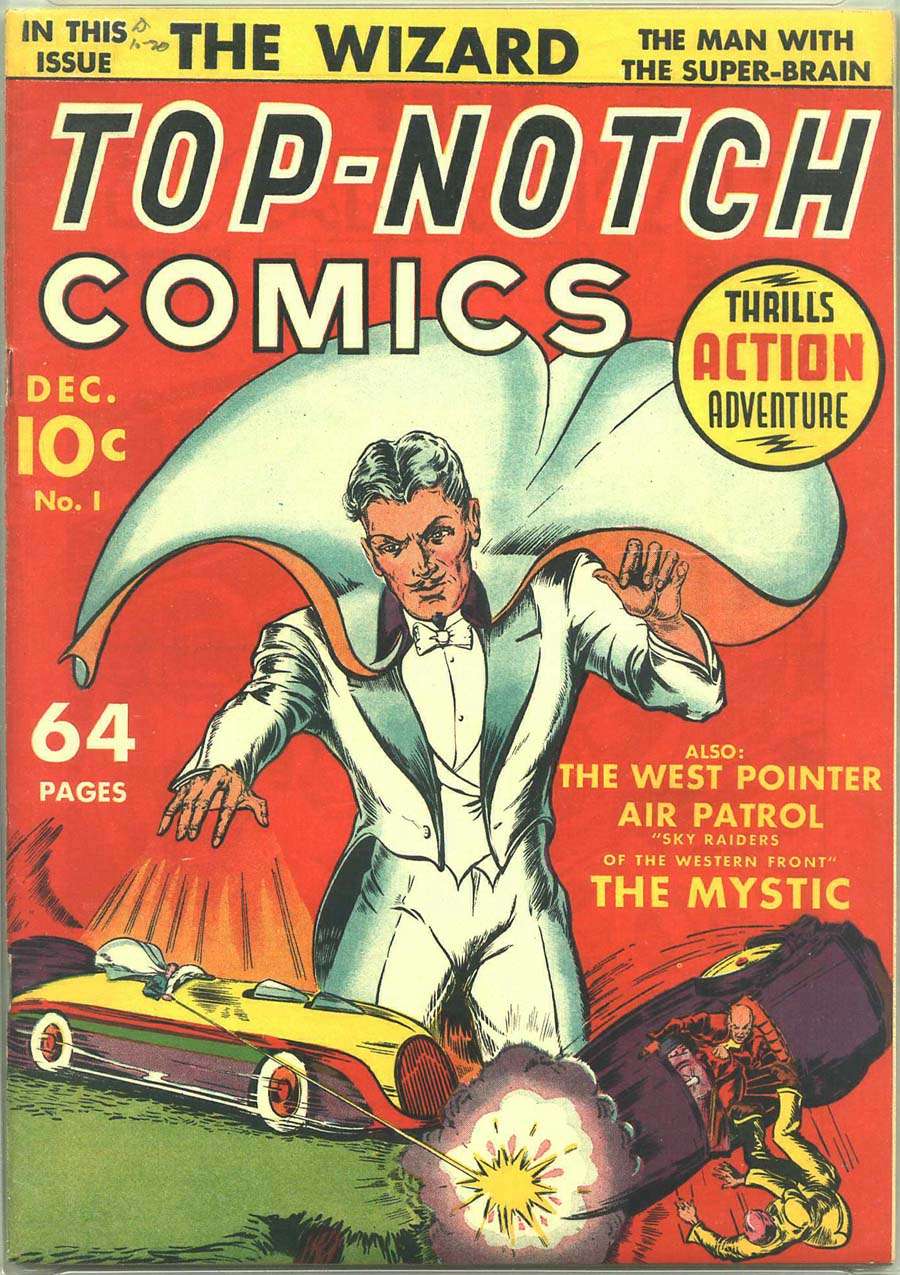
With both Blue Ribbon Comics #2 and Top-Notch Comics #1 (also released this month), MLJ took the plunge into the world of superheroes, with ‘Bob Phantom’ making his first appearance later in this issue, and here on the inside front cover with an ad for ‘The Wizard’ created by Will Harr and Edd Ashe.
(from Blue Ribbon Comics #2 - October 1939, artwork by Edd Ashe)

Rang-A-Tang the Wonder Dog would be the only feature to appear in every issue of Blue Ribbon Comics, and the subject matter here, once again starts off pretty heavy with kidnapping, suicide, arson… oh, and half naked girls! Rang-A-Tang has his paws full!
(from Blue Ribbon Comics #2 - October 1939, story by Norman Danberg, artwork unknown)

Bob Phantom would be one of the two first superheroes to appear for MLJ, thought to be written by Harry Shorten but certainly drawn by Irv Novick, in what has to be one of his earliest works (it’s his first story). Dan Hastings had another sci-fi adventure, Jack Cole did a few one page strips, but the emphasis was already starting to learn towards more adventure and crime… superheroes were on the way!
(from Blue Ribbon Comics #2 - October 1939, artwork by Irv Novick)

TOP-NOTCH COMICS #1
(On Newsstands in October 1939)
The Wizard would get top billing here, making him the first MLJ Superhero to appear on one of their covers! Like Blue Ribbon Comics, Top-Notch was a 64 page Anthology primarily consisting of new material!
(from Top-Notch Comics #1 - October 1939, artwork by Edd Ashe?)
One of the coolest pieces of early art - I mean, how much cooler can you get than Rang-A-Tang the Wonder Dog chomping down onto an Octopus underwater?
And this is considered to be Irv Novick’s FIRST published piece of work!
Sure, Inside we’d see more early Jack Cole one pagers, crime stories, sic-fi stories, etc., but THIS inside front cover….
A great early pin-up from one of the long time greats Irv Novick! Who’d have thought he’d be a regular penciler on Batman some 35 years later?
(from Top-Notch Comics #1 - October 1939, artwork by Irv Novick)

Before he was even old enough to have a pencil thin mustache, young Blaine Whitney, aka ‘The Wizard’ gets some solid advice from President Woodrow Wilson!
(from Top-Notch Comics #1 - October 1939, artwork by Edd Ashe)

Just an all around great guy!
(from Top-Notch Comics #1 - October 1939, artwork by Edd Ashe)

Ok, so he does, sort of, have a costume… a cape, and one of those Green Hornet masks (actually the Green Hornet, was only a radio program at this time, and wouldn’t appear in comic form until the following Fall of 1940). Eddy Ashe showing some style in his art here in the early days of comics….
(from Top-Notch Comics #1 - October 1939, artwork by Edd Ashe)

Sci-Fi was a big part of these anthologies and Scott Rand and Dr. Meade travel through time in their spaceship meeting all kinds of ‘handy’ people….
(from Top-Notch Comics #1 - October 1939, artwork by Jack Binder)

Another ‘superhero’ was Kardak the MYSTIC, featuring more stories of crime, bondage and real slappin’!
(from Top-Notch Comics #1 - October 1939, artwork by C.A. Winter)

Of interest this month, besides the very cool MARVEL MYSTERY COMICS #2, there was JUNGLE COMICS #1 from Fiction House , and FANTASTIC COMICS #1 from Fox Features making their debut.
Books published by MLJ Publishing (Archie Comics) and on the stands in October of 1939
BLUE RIBBON COMICS #2
TOP-NOTCH COMICS #1
Monday, June 1, 2015
From the Start:
BLUE RIBBON COMICS #1
(On Newsstands in September 1939)
Let's go back to September of 1939:
Superman was a year and a half old, Batman was only making his 7th appearance in Detective, and Robin wouldn’t show up until the following Spring (followed by Batman’s own title a month after that). Marvel Comics #1 had debuted the previous month in August.
But there it was! MLJ, who would later become what we now know as Archie Comics, had their first comic book on the stands!
(Blue Ribbon Comics #1 - on the stands in September 1939, story by
Norman Danberg featuring Rang-a-tang the Dog)

Jack Cole (who’d go on to create Plastic Man two years later) did the inside front cover.
(from Blue Ribbon Comics #1 - September 1939, artwork by Jack Cole)

Welcome letter
(from Blue Ribbon Comics #1 - September 1939)

Even though it was primarily made up of new HUMOR material, the harsh realities of the time are apparent from the opening story… thank goodness Rang-a-Tang is there!
(from Blue Ribbon Comics #1 - September 1939, story by Norman Danberg, artwork unknown)

Sometimes, in the infancy of comics, things can be unintentionally funny, and of course other times, not so much, as here in this Flash Gordon influenced Dan Hastings character, in the Mexidian Raiders! (???)
(from Blue Ribbon Comics #1 - September 1939, artwork by Clem Gretter)

Comics in the very early years already establishing itself as somewhat counter-culture with it’s hip jargon.
(from Blue Ribbon Comics #1 - September 1939, artwork by Jack Cole)

Also in September of 1939, Paul Robeson’s The Avenger would debut in “Justice Inc.” in the Avenger Magazine #1

Books published by MLJ Publishing (Archie Comics) and on the stands in September of 1939
BLUE RIBBON COMICS #1
Saturday, May 23, 2015
PEP COMICS #83
(On Newsstands in November 1950)
SUBSCRIBE to Undercover Archie and get an e-mail reminder every time there's a new post!
Man, my copy of this is beat up, but hey, how many Pep #83’s you see laying around? This ‘secret note in the classroom’ motif would become a regular in gag in Archie Comics for decades. Not sure who the artist is, but my guess would be George Frese.
(from Pep Comics #83 - November 1950, artwork by George Frese?)

See, now Betty’s always willing to help Archie, but she’s smart enough NOT to gather the better looking girls from school. A Gabby appearance!
And really? Someone has the name ‘Blimpe?'
(from Pep Comics #83 - November 1950, artwork by Bill Vigoda?)

I wouldn’t be surprised if a young Robert Crumb saw this panel, and got an early sprinkle of imagination from it… it’s certainly not something you’d see in a mainstream Archie Comic today as here they drew those women big and ugly to throw Archie around like a rag doll!
(from Pep Comics #83 - November 1950, artwork by Bill Vigoda?)

Now if this panel doesn’t make you curious to go read some of these old Archie stories I don’t know what will.
(from Pep Comics #83 - November 1950, artwork by ?)

DARLING ROMANCE #7
(On Newsstands in November 1950)
This was Darling Romance’s last issue, and with it, they finally went with an artist drawn cover instead of a picture cover, and they sure didn’t hold back on the intensity of the scene! As cheap as they could, they simply copied and re-edited this drawing from the splash page of the first story inside!
(from Darling Romance #7 - November 1950, artwork by ?)

Here’s what they had been doing… were magazine buyer’s confused and tricked into buying comics?
(from Darling Romance #5 - Spring 1950, photograph by ?)

I wish we had more information on who some of these artists were (and writer’s) as I find this genre so entertaining. The innuendo, the creative freedom… if they could’ve just added a bit more pizzaz to the endings, like something from EC Comics, this work could’ve been classic. As is, the endings are usually pretty predictable…
My full review on this series is here: Darling Romance Review
(from Darling Romance #7 - November 1950, artwork by ?)

...though there ARE times when some of the stories almost LOOK like they’re out of an EC Comic…. which is weird for Archie Comics...
(from Darling Romance #7 - November 1950, artwork by ?)

DARLING LOVE #7
(On Newsstands in November 1950)
Darling Love would go on for a few more issues, sporadically strung out over the next year and half… I guess somehow sales were better for this as it switched over to the artist drawn covers with this issue.
Here’s review of the full series: Darling Love Review
(from Darling Love #7 - November 1950, artwork by ?)

I wanted to include this story for a number of reasons…1. Because it’s pre-Archie Harry Lucey art, which is very cool, and #2 because it’s a STUNNING example of what UNDERCOVER ARCHIE is looking for!
‘Too Fat for Love?’ I’m even offended by the title lettering of the story!
Classic 50’s stuff - this was just reprinted in Weird Love #2, a reprint series from IDW that came out last year!
(from Darling Love #7 - November 1950, artwork by Harry Lucey)

Wow… just wow. Poor Mona! That Tommy is a jerk!
(from Darling Love #7 - November 1950, artwork by Harry Lucey)

Motherly advice... what's also interesting is that first/second generation immigrant relationship, which today seems completely alien to us, but back then was very much a part of America....
(from Darling Love #7 - November 1950, artwork by Harry Lucey)

Sadly enough, the story doesn’t even end with any real justice. Mona is continually cursed in love, (while ignoring the one guy who WILL date her as is, maybe there’s some truth THERE) until, broken hearted, she gets ill and bed ridden, and sheds all of her weight, to come out looking like the woman below…
Oh! That’s all there is to it!
(from Darling Love #7 - November 1950, artwork by Harry Lucey)

Books published by Archie Comics and on the stands in November of 1950
ARCHIE COMICS #48
BETTY and VERONICA #2
DARLING LOVE #7
DARLING ROMANCE #7
FAUNTLEROY COMICS #1
PEP COMICS #83
Monday, May 11, 2015
ARCHIE COMICS #48
(On Newsstands in November 1950)
The new scanner works great and it's just in time for one of the more famous Bob Montana covers. This is some pretty forward sexual innuendo between two teenagers in 1950, even for an Archie comic.
(from Archie Comics #48 - November. 1950, artwork by Bob Montana)

Mr. Andrews looks a little more nervous than he should as Betty struts around in her 'revealing' swim suit.
Adults in Archie Comics always seemed to sweat and get big eyed around sexually charged situations...
(from Archie Comics #48 - November. 1950, artwork by Samm Schwartz?)

You'd have to have been there....
(from Archie Comics #48 - November. 1950, artwork by Samm Schwartz?)

The language and phrases of the day were different in 1950...
(from Archie Comics #48 - November. 1950, artwork by Bill Vigoda)

ARCHIE's GIRLS BETTY and VERONICA #2
(On Newsstands in November1950)
This was George Frese's book and he helped give it his own 'House Style' look. I can spot his art almost as fast as anyone...
(from Betty and Veronica #2 - November. 1950, artwork by George Frese)

The books of Betty and Veronica mirrored much of what Woggon would do with his Katy Keene book, in trying to get to know them by name and make them feel a part of a special club.
(from Betty and Veronica #2 - November. 1950, artwork by George Frese)

I never get tired of these stories where Betty and Veronica try and cook, especially when Jughead acts as melodramatic as this...
(from Archie’s Girls Betty and Veronica #2 - November 1950, artwork by George Frese)

and ESPECIALLY when they include some tasty Undercover Archie moments of 1950’s cultural stereotypes!
(from Archie’s Girls Betty and Veronica #2 - November 1950, artwork by George Frese)

Georege's splash pages were always nicely laid out in a traditional Archie style, yet he had a special feel to them all his own. Such an underrated, tragically short, history as an Archie artist...
(from Betty and Veronica #2 - November. 1950, artwork by George Frese)

George Frese sure knew how to draw these Veronica kisses… and Archie’s reaction to them!
(from Archie’s Girls Betty and Veronica #2 - November. 1950, artwork by George Frese)


Jughead as excited about this ad as he is anything other than eating...
(from Archie’s Girls Betty and Veronica #2 - November. 1950, artwork by ?)

I spent about 15 minutes on Google and couldn’t figure this out… anyone?
(from Archie’s Girls Betty and Veronica #2 - November. 1950, artwork by George Frese)

Books published by Archie Comics and on the stands in November of 1950
ARCHIE COMICS #48
ARCHIE’s GIRLS BETTY and VERONICA #2
ARCHIE’s PAL JUGHEAD #2
DARLING LOVE #7
PEP COMICS #83
FAUNTLEROY COMICS #1
Sunday, March 29, 2015
ARCHIE's PAL JUGHEAD #3
(On Newsstands in October 1950)
SUBSCRIBE to Undercover Archie and get an e-mail reminder every time there's a new post!
My scanner is down and I’m kind of dragging my feet to buy a new one, so in order to not get too far behind, it’ll be a digital picture edition of Undercover Archie for now!
Here's a George Frese cover, taking what he’d learned from Bob Montana and using it well!
(from Jughead #3 - October 1950, artwork by George Frese)

Speaking of learning from, it appears George learned a trick or two about exaggerated body motion from Samm Schwartz and has it on display here in one of the better Golden Age Jughead stories ‘The Rubber Bonanza’.
(from Jughead #3 - October 1950, artwork by George Frese)

I’ve been watching MASH on Netflix from the very start, and as much as I see the influence of Groucho Marx in the verbal syntax of Hawkeye Pierce, there are times when somebody is writing Jughead that it sounds virtually the same to me. And those stories are usually drawn by George Frese.
(from Jughead #3 - October 1950, artwork by Samm Schwartz)

Jughead peddling select Archie titles! And looking as thrilled about it as you'd expect!
(from Jughead #3 - October 1950, artwork by Unknown)

The original inspiration for Zap Comix #1? Was it ‘shocking’ for Jughead to appear butt naked in a comic book in 1950?
(from Jughead #3 - October 1950, artwork by Bill Vigoda)

ARCHIE'S RIVAL REGGIE #2
(On Newsstands in October 1950)
Sweet looking copy, right? Nah, spine is split completely… ah well, looks good in a mylar! And another great George Frese cover! George is becoming a star at Archie Comics, as both covers and nearly every piece of art in these two books is by him!
(from Reggie #3 - October. 1950, artwork by George Frese)

That pretty much says it all!
(from Reggie #3 - October. 1950, artwork by George Frese)

George Frese breaking the panel barrier in one of the more creative ways I’ve seen in an Archie comic...
(from Reggie #3 - October. 1950, artwork by George Frese)

Be careful what you wish for… Veronica can’t resist the proper make-over of the new dapper Jughead….
(from Reggie #3 - October. 1950, artwork by George Frese)

Reggie tries to go straight.. to disastrous results. George Frese is on a roll in one of the better Reggie stories of the Golden Age.
“To Be Or Not To Be"
(from Reggie #3 - October. 1950, artwork by George Frese)

Books published by Archie Comics and on the stands in October of 1950
Archie's Pal Jughead #3
Archie's Rival Reggie #2
Katy Keene #2
Laugh Comics #42
Super Duck #35
Suzie Comics #78
Wilbur Comics #34
Subscribe to:
Posts (Atom)